Home > Women > Health & Kitchen
I Cooked My Family's Breakfast In The Same Pan For Years Before A Food-Safety Researcher Showed Me What The Surface Was Hiding (Check Your Pan Right Now)
By: Sarah Mitchell, September 2026
Reading Time: 5 min read
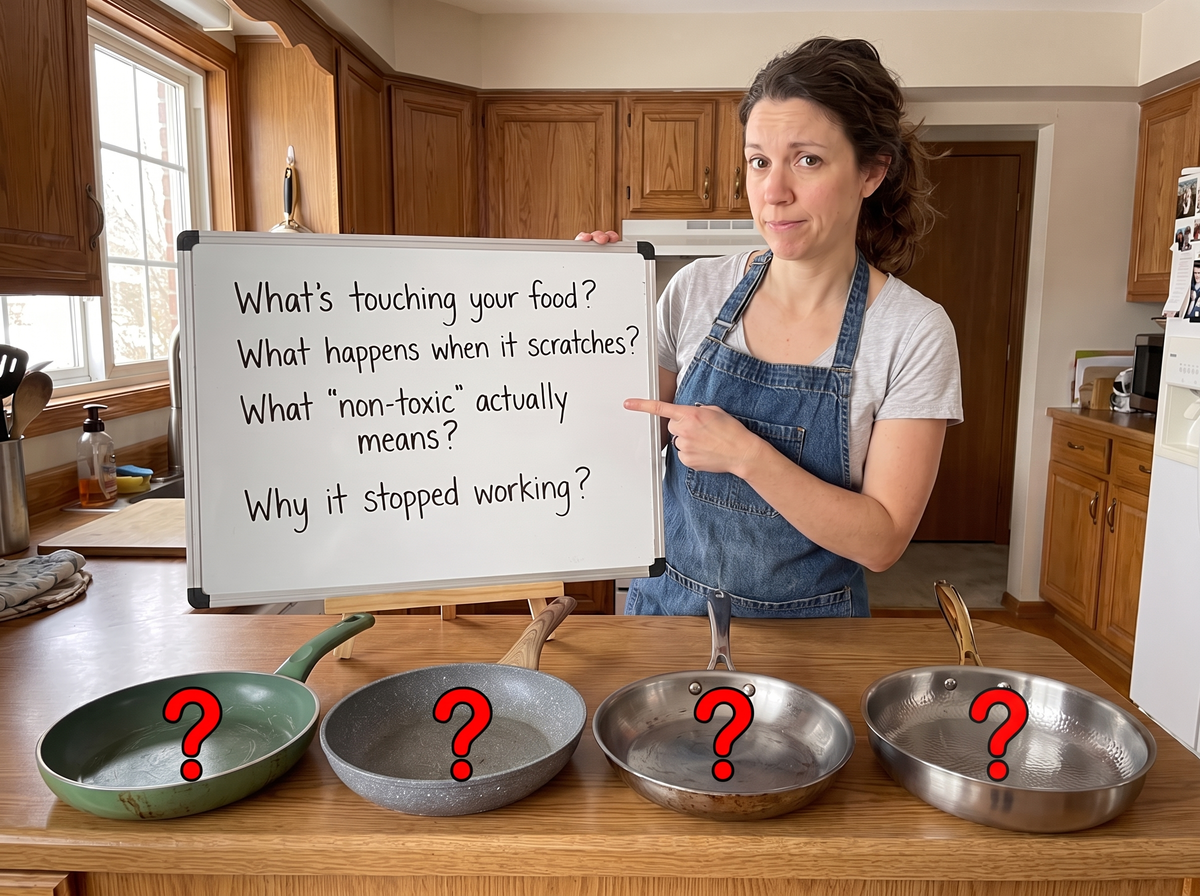
Go grab the pan you use most mornings right now.
I'm serious. Go get it. I'll wait.
Now look at it like you probably never do when breakfast is already happening. Not as "the egg pan." Not as "the easy one." Not as the pan everyone reaches for because it just gets the job done.
Looks normal, right?
Used, but normal. Like something that has made hundreds of breakfasts and can probably make hundreds more.
That is what I thought too.
For years I stood at that stove making eggs, pancakes, and quick lunches for my family without asking the one question I should have asked sooner.
Not "does it still cook?"
Not "is it bad enough to throw away?"
Not even "is it safe?"
The question was simpler:
What is my food actually touching now?
That question bothered me because I had checked everything else. The groceries, my kids' snacks, the containers, even the water filters.
But the pan I used almost every morning was the one thing I had barely looked at.
Then at a friend's dinner, a food-safety researcher overheard me say: "I just want one pan I don't have to worry about."
She asked what I was using.
I told her.
She went quiet for a second. Not dramatic. Not judgmental. Just quiet enough that I noticed.
The next morning she came over for coffee.
She picked up the pan I used almost every morning, tilted it toward the light, and turned it over.
"Read that," she said.
Down on the base, in small print I had never noticed:
Do not use metal utensils.
"That is the most honest line on the whole pan," she said. "And I am going to show you exactly what it means."
That was the moment my normal frying pan stopped feeling normal.
I Fell For "Healthy Non-Stick" For Three Years (And Blamed Myself Every Time It Failed)

My name is Sarah Mitchell. I spent three years and $640 on pans that could never last.
Four different brands. GreenPan. Caraway. The Always Pan. Even the HexClad with the pattern, the one that was supposed to be the last pan I'd ever buy.
$89 here. $145 there. $226 for the "premium" one with 12,000 five-star reviews.
All coated. Every single one.
Still scraping eggs off the bottom at 7 AM. Every single morning.
Still standing at the sink scrubbing a pan that was supposed to clean itself.
Still keeping one cheap non-stick in the cupboard "just for eggs" and feeling a bit sick every time I reached for it.
Still googling "is a scratched pan safe" at 11 PM instead of sleeping.
And every time one failed, I decided it was me. Too much heat. Wrong spatula. Dishwasher once too often.
I had become the mum who reads every label in the supermarket and then cooks it all in a pan she doesn't trust. The wife with a drawer full of dead pans who still couldn't answer "which one should I just use."
My husband finally said: "Just pick one. It's a pan."
She turned each one over. Read the base. The same small warning stamped into every single one.
Do not use metal utensils.
"That warning is there for one reason," she said. "Your pan has a coating on it. A layer sprayed on top of the metal. Thinner than half a hair. That is the only part that is non-stick. And a layer that a fork can damage is a layer that comes off a little at a time."
I stared at her.
"So my ceramic pan-"
"Has a coating. Your PFOA-free one. Your hybrid. All of them. Different names on the front. Same layer underneath."
That was the moment three years of failed pans suddenly made sense.
Here is what should make you furious:
They know.
Every brand printing "Non-Toxic" on the front while stamping "do not use metal utensils" on the bottom?
They know exactly how long that layer lasts.
A coating costs pennies to spray on. A surface that doesn't need one costs ten times more to make.
So they choose a new pan every year over a pan that lasts.
Every. Single. Time.
What Cookware Experts Say Behind Closed Doors

She showed me a private industry forum. Only materials engineers and safety testers can access it.
Thread after thread:
"Customer says the ceramic pan stopped working. I check the wear layer. Gone after eight months. This is not a defect. This is the design."
"Front of the box: PFOA-Free Non-Stick. Bottom of the pan: Do not use metal utensils. That is the whole story."
"Industry built on a coating that runs out and careful parents who blame themselves when it does."
Then another section. Testers sharing real results:
"Switched test kitchen to a coating-free surface. Month eight. Same as day one. Metal spatula, dishwasher, no problem."
"This is what cookware is supposed to be. Everything else is temporary."
I asked her: "Why doesn't every brand just make a pan without a coating?"
She looked at me like I was naive.
"Because they'd sell you one pan instead of four. They need you saying 'maybe I ruined it with too much heat,' trying the next brand, never reading the bottom. A pan that lasts is a customer lost."
The Science: Why A Surface With No Coating Works

She explained it to me like I was five years old. And honestly? That is what I needed.
"Every non-stick pan works the same way," she said. "A coating is sprayed on top of the metal. Teflon, ceramic, hybrid, it doesn't matter what they call it. It is the only part that is non-stick."
"Every time you cook, a little of it goes. The heat takes some. The spatula takes some. The dishwasher takes some. When it is gone, you are cooking on whatever was underneath."
I did the math in my head.
"So my ceramic pan was only ever non-stick for about 150 breakfasts?"
"Essentially, yes. After that you're cooking on whatever was underneath."
Then she said something that stopped me cold:
"There is only one kind of pan that cannot lose its coating. A pan that does not have one. Instead of spraying a layer on top, you shape the metal itself. Thousands of tiny peaks. Food sits on the peaks, not flat against the pan. Less contact, less sticking. Nothing to run out because nothing is on top."
"The surface is titanium, so it doesn't react with your food. Underneath is a steel body so it heats evenly and works on induction. It won't feel like Teflon on day one. Medium heat, a teaspoon of oil, and by the fourth cook the eggs let go. Then they keep letting go, because there is nothing there to run out."
I asked her: "Why doesn't anyone tell you this when you buy a pan?"
"Because the person in the shop read the front of the box. Same as you."
Why They Don't Want You To Know

Go look up the top-selling "healthy" pans on Amazon right now.
I'll wait.
GreenPan. Caraway. HexClad. Our Place.
Scroll down. Find the care instructions.
Low to medium heat only. Avoid metal utensils. Hand wash recommended. Replace if surface is damaged.
These are not small companies making mistakes. They have labs. They have scientists. They have teams of lawyers writing those care guides carefully.
They KNOW the coating wears.
But a coating costs pennies to spray on. A surface that doesn't need one costs ten times more to make.
So they made their choice.
Profit over your mornings. Profit over your peace of mind. Profit over your family.
Every. Single. Time.
They need you buying pan after pan.
Saying "the ceramic one just stopped working."
Blaming yourself.
Thinking you are a bad cook.
Never reading the bottom.
You just broke the cycle.
The Pan She Actually Recommended

Before she left, I asked her one more question.
"If someone wanted a pan with no coating, one that actually cooks eggs, what would you tell them to buy?"
She didn't hesitate.
"Sear. Small operation. They make one thing. A titanium surface on a steel body, no coating. No games. It is what the description says it is."
Then she pulled up their lab report on her phone.
"See this? Report number. Date. The laboratory's name. Heavy metals tested, not detected. Most brands won't publish this because they'd have to explain what is actually on the surface. These people post it because they have nothing to hide."
Here's what makes Sear different:
✅ No Coating The cooking surface is titanium shaped into thousands of tiny peaks. Nothing sprayed on top. Nothing to wear off. There is no "month five."
✅ Steel Body Underneath Multi-layer steel and aluminium so it heats evenly and works on induction. No coating between the metal your food touches and the heat.
✅ Lab Tested, Report Published Arsenic, cadmium, lead and antimony: not detected. Report number and date on the site. Read the actual report, not a badge.
✅ No Rules To Follow No coating to protect. Metal utensils, dishwasher, oven. Stop babying your pan.
✅ Cook On It First Not Teflon, and they say so. Medium heat, a teaspoon of oil, eggs release by the fourth cook. 120 days to try it. If it is not the best pan you have owned, send it back.
I pulled out my phone and ordered right there at the table.
What It Already Cost You
I did the maths after she left.
Because she was right. I had not bought one bad pan. I had bought the same coating four times.
GreenPan ceramic - $89 - 6 months
Caraway - $145 - 8 months
The Always Pan - $89 - 5 months
HexClad - $226 - 11 months
$549. Gone.
And that is just the money.
It does not count the mornings scrubbing a pan that was supposed to clean itself. The butter I kept adding because things were catching. The 11 PM searches trying to figure out what I was doing wrong.
It does not count the cheap non-stick I kept "just for eggs" and reached for every time the good pan was a fight.
A coating costs the brand pennies.
It cost me three years.
What Women Are Saying (The Groups Don't Lie)

The parenting forums tell the real story. Women who had given up on safe pans, who had been burned by ceramic and hybrid, discovering a surface with no coating and feeling betrayed that no one told them sooner.
On whether it actually works for eggs:
Rachel M., 34, mum of two: "Tried ceramic THREE times. Always said 'maybe I'm using it wrong.' The first two mornings the eggs stuck a little. By the fourth they slid. Month four now. Metal spatula, dishwasher, no problem. I cannot believe I spent $400 on coatings."
On whether it is just another titanium scam:
Karen T., 41: "Every titanium ad looks the same. What got me was the lab report with the actual report number. I looked it up myself. Two eggs stuck the first morning. By the fourth they didn't. My husband uses it now without being asked."
On whether PFOA-free means anything:
Hannah B., 39, paediatric nurse: "I didn't know PFOA-free just meant a different coating. I had been telling families to buy ceramic for years. The only pan that cannot lose its coating is one that does not have one."
On whether the husband will actually use it:
Meg F., 37: "He refused to touch the ceramic one because the instructions were so strict. He uses this without thinking about it. That is the only review I need to give."
⚠️ Important Stock Warning

This is where I have to be honest with you about availability.
Sear isn't like the big brands. They don't spray a coating on and ship it the same week. The surface is hammered and bonded to a steel body, then every batch is lab tested before it leaves.
That's six weeks minimum per batch.
They sell out four to five times a year. When a size is gone, there's a six-week wait for the next batch.
Right now the 26cm, the one most of us use every morning, is down to 127.
What happens when these sell out:
❌ Six-week wait minimum for the next batch
❌ Price goes up on restock
❌ No Amazon. No shops. Only through their website.
This is their lowest price this year.
If you're reading this and there's still stock, I'd grab it now.
If you see "SOLD OUT," you waited too long. Get on the waitlist.
Two Paths Forward

Path 1: You close this page.
Nothing changes.
Tomorrow morning you reach for the same pan. The eggs catch at the edge. You add more butter and scrub it clean. Again.
Next week you're still googling "is a scratched pan safe."
Next year it goes in the bin and you buy the next one. New name on the front. Same coating underneath.
Six months from now? Same sticky patch. Same drawer of dead pans. Same quiet guilt every time you reach for the one you don't trust.
Path 2: You check if Sear is still in stock.
Takes 30 seconds.
You see if your size is available. You order the one you use every morning.
Tomorrow morning, medium heat, a teaspoon of butter. The first few cooks feel a little different.
By the fourth, they slide.
By week two you're using the metal spatula and putting it in the dishwasher.
By month one you tilt it toward the window and it looks like day one.
Six months from now? The pan isn't something you think about anymore. Breakfast is just breakfast. And you know exactly what your kids' food is touching.
The choice is yours.
